Your Giving Makes a Difference - Allen's Story
Six-year-old Allen before surgery

Six-year-old Allen before surgery

By Co-Founder, Susan Gustafson

“At some point in the next year or two, Allen will be strong enough for a life changing surgery. He will wake up groggy in bed, free of his G-tube, with his mom nearby. He will take a few weeks to heal. An then he will sit down to the first proper meal of his life...”
— Volunteer, Angel Hertslet

Some of you may remember this excerpt from the FAME Blog. If not, you can read the FIRST part of the story here. Six-year-old Allen came to FAME suffering from severe malnutrition and pneumonia. The malnutrition was the result of a congenital problem, a stricture in his esophagus, that prevented him from swallowing food. Well, life took a dramatic turn for Allen 18 days ago today. He and his Mother traveled to Switzerland with volunteer pediatrician, Dr. Verena Moreno on November 5th, and on November 11th he had the surgery he’s been waiting for his whole life: A resection of the narrowed part of his esophagus and an end-to-end anastomosis reconnecting his esophagus to the stomach. Of course, this journey did not materialize overnight.

The complex surgery Allen needed is not yet performed in Tanzania. We had to find a surgeon and a hospital willing to do the surgery AND we had to keep Allen alive long enough to make it happen. For 10 long months, Dr. Verena and the FAME team have been caring for Allan, treating him when he got sick, providing the nutritional supplements he needed to build strength, and teaching his mother how to mix the F-100 nutritional formula and give it to him thru his feeding tube on a daily basis. Mind you, Allen and his mother have no running water in the poor, rural village where they live. Nothing is easy to keep clean, let alone a feeding tube inserted in the stomach.  While only a short-term solution, it was a successful one – one in which Allen’s mother played a central role. She made absolutely sure he received the nutritional formula thru his feeding tube on schedule. She was religious about keeping it clean, and she arranged to bring him in to FAME whenever she had a concern or felt something was amiss. Slowly, Allen began to gain the weight and strength necessary to stay alive while waiting for a miracle.  And the miracle finally came.  Dr. Verena received word that a surgeon and hospital in her home town of Bern were willing to donate their time, expertise and facility to perform the surgery that would save Allen’s life.

The lastest update from Dr. Verena on November 19th was very encouraging, “Allen is recovering well. He is still in the hospital because he has some drainages, nasogastric tube and IV ailmentation. On Monday they will do an X-ray (Barium meal) to see if the anastomosis they did is functioning well. Afterward the drains and the NGT can be removed and I think mid-week he will leave the hospital. The convalescence will be at my home.” 

Allen is only one of many, many children cared for by the FAME team. Fortunately, the vast majority can be treated right here at FAME Medical.  We have been able to maintain and grow our “in-house” programs and services thanks to the generosity and ongoing commitment of our supporters and friends.  Thank you for helping us care for the most vulnerable among us – in a place where the usual safety nets simply do not exist. You are their heroes and ours.

A Shuka, A Goat and Two Chickens
Martina presents Dr. Duane with a Shuka

Martina presents Dr. Duane with a Shuka

By Nancy Allard

Thanksgiving came a little early this year at FAME. One of our former patients paid us a visit. Some of you may remember Martina, a patient who came to FAME in 2014 with second and third degree burns over 35% of her body, some already infected. She ended up spending the next 342 days in FAME’s inpatient ward fighting for her life and being cared for by our team. Well, Martina got word that visiting surgeon, Dr. Duane Koenig, had returned to FAME Medical for another volunteer stint and she wanted to personally thank him for the central role he played in saving her life. You see, Dr. Duane is the one who brought skin grafting to FAME Medical, donating the equipment and training his Tanzanian colleagues in the procedure.  He personally performed hours and hours of grafting on Martina and was very often at her side during the multiple dressing changes and debridements that followed.  And in his face she saw someone completely and absolutely unwilling to give up on her. By the time Martina was finally discharged, Dr. Duane had already returned home to Nebraska. Having graciously thanked the others involved in her care, she still had not been able to “properly” thank the man whose face gave her hope thru her darkest moments, until two weeks ago when she and her husband received word of his return.


How to thank someone who saved your life?  How about a shuka, a goat and two chickens -- that was Martina’s gift to her friend Dr. Duane. And his response, “Thank you. I would have gone to hell and back for you. I don’t need anything. My reward is to see you beautiful and smiling.” It was an extraordinary moment, one filled with joy, smiles and laughter - a magical moment between a patient and a doctor who share a special bond for life. 

Happy Thanksgiving to our generous supporters and partners, who continue to pave the way for powerful moments like these between patients and doctors at FAME Medical.  We are forever grateful to be sharing this journey WITH you.


Martina and her husband gift Dr. Duane with two chickens

Martina and her husband gift Dr. Duane with two chickens

Volunteer EntriesGuest User
Helping Those With Chronic Disease At FAME Medical
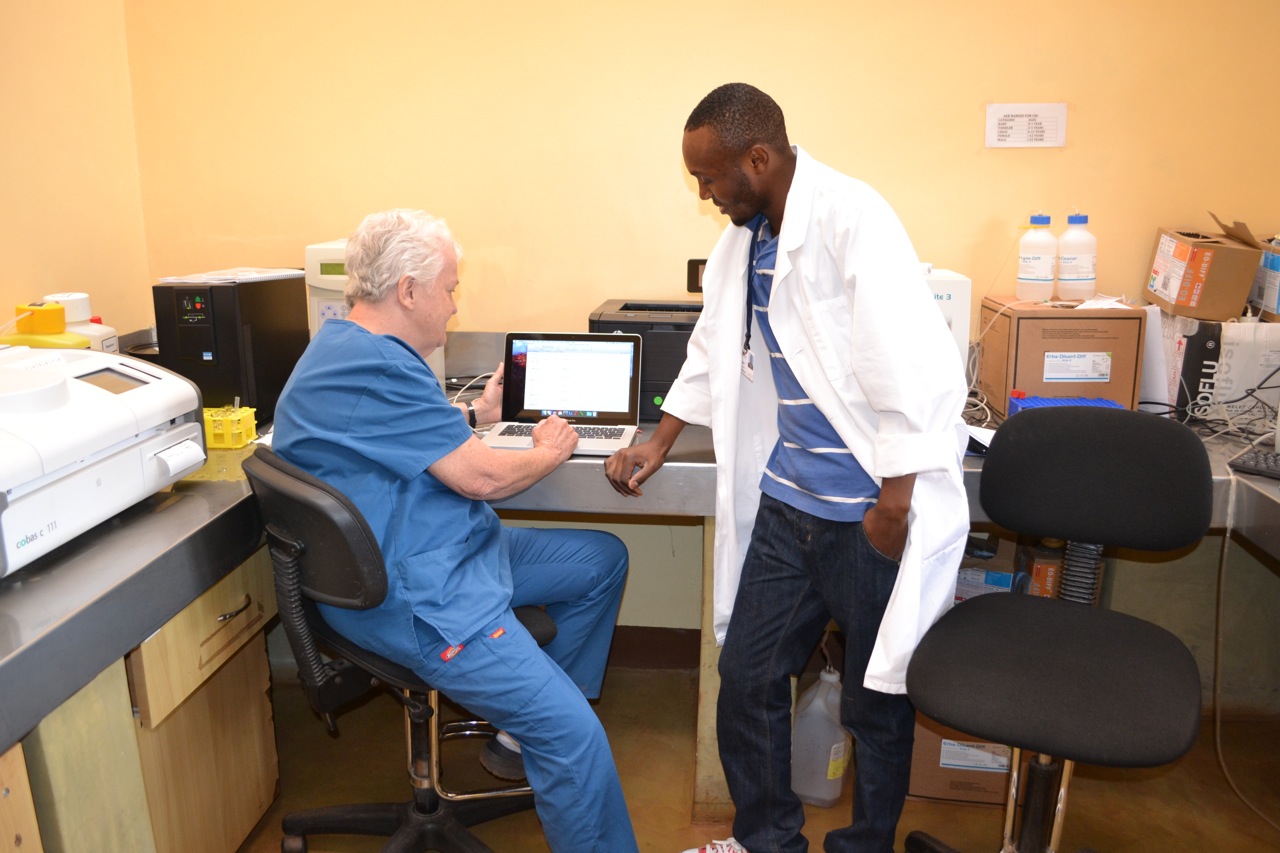
Dr. Joyce and Rizwani at work in the lab 

Dr. Joyce and Rizwani at work in the lab 

by Volunteer, Dr. Joyce Cuff

We continue to see a wide variety of patients at FAME Medical. Not only are there lots more patients coming to FAME, they now range from the very healthy and just checking category, to the comatose and at death's door group. I rejoice in the increasing number of patients being monitored for chronic or life-style diseases. For the most part, these are otherwise healthy people whose clotting time is being monitored to prevent stroke or other cardio-vascular complications, whose blood sugar needs to be and can be controlled, whose lipids are being monitored and controlled, or whose thyroid levels are monitored periodically to keep them functioning well. These are conditions that, even 5-10 years ago would remain unmonitored and possibly even undetected, as many are asymptomatic until you're in real trouble. Being controlled and being monitored before an incident occurs increases the likelihood that they will not become clinical or critical. Of course, with so many more patients in dire straights when they arrive, we are unable to save them all. That is a harsh reality that cannot be changed. But the miracles continue to abound and astound.

Volunteer EntriesGuest User
Building Surgical Capacity at FAME Medical

BY VOLUNTEER SURGEON, LOIE SAUER

Dr. Frank and Dr. Loie in outpatient clinic

Dr. Frank and Dr. Loie in outpatient clinic

In clinic one day, a woman presented with signs of appendicitis.  Dr. Msuya and Dr. Lisso recommended appendectomy, and we proceeded to the “operating theater”.  She was skillfully put under general anesthesia by one of FAME’s two nurse anesthesists. As we were halfway through the procedure, I could have closed my eyes and felt like I was in any operating room anywhere in the world, as it is an environment so consistent to those of us who spend much of our lives in them.  The familiarity of being in gown and glove. The sterile field. The friendly chatter.  The sound of the cautery machine. Sometimes the music or the jokes. But always the sense of teamwork and the intense focus when the procedure calls for it.

This really rang true when toward the end of the procedure, I felt a little something moving on my shoulder.  It was Siana, the scrub nurse, doing what all of us do when our nose itches and we can’t scratch it with our sterile gloves:  we rub our nose on the shoulder of the person next to us.  I laughed out loud because that same gesture occurs zillions of times per day in operating rooms around the globe.

FAME’s two operating rooms are beautiful.  Nice lights. Natural light through windows. Pristine clean. Cabinets housing supplies of all kinds.  What is remarkable is that it is revolutionary in the region.

You see, in places like East Africa, and other low or middle income countries, death rates are high for common, easily treatable conditions like appendicitis, hernia, obstructed labor, bowel obstruction, and burns, for lack of surgical capability. Last year, the global health attention was riveted on the report of the Lancet Commission on Global Surgery, which reported that 5 billion people worldwide do not have access to safe, affordable surgical and anesthesia care when needed.  In addition, the absence of a safe blood supply is a crucial problem globally in treating surgical conditions.

FAME, by virtue of offering primary surgical services, reliable anesthesia services, and a safe blood supply through its own collection, offers residents of the Karatu region what many in the world do not have. 

Our patient did well and went home in a day.  While at FAME I participated in procedures such as C-section, hernia, tonsillectomy, burn management, breast abscess, and appendectomy. Using teaching tools from UCSF that included videos, knot tying boards, suture practice materials, we had fun working on surgical skills. FAME, you all are awesome! 

Guest User
The Long Road to Health

By Angel Hertslet

Six-year old Allan came to FAME a few weeks ago with a serious medical issue: he could not swallow food.

Most of us count eating food as one of the great joys in life, and how easy it is to take it for granted. Although Allan greeted the medical team with smiles and laughter, his situation was grave: he weighed only 22 pounds (10 kilos), the weight of a healthy one-year old. To complicate things, his small malnourished body was suffering from chest rattling pneumonia.

FAME Medical treated Allan for his pneumonia and started him on nutritional support. After a few days of charming the doctors and nurses, he was stable enough to return home. Yet Allan’s esophagus was still constricted and only a complex surgery could address this congenital problem. FAME Medical began the search for someone who could operate on Allan, sending emails to the extended family of FAME supporters.

Luckily, a few people were well positioned to help him. The first was a doctor in Arusha who had seen Allan before and knew of his need for esophageal surgery. A specialized pediatric surgeon from Finland came to volunteer at her hospital, so she called FAME and invited Allan to return for surgery. The second was an anonymous donor, well aware of his situation, who committed to helping him get the best care possible. It would be remiss not to mention Brad, the nurse practitioner at FAME, and Angel, the social worker, both of whom took on the responsibility of traveling with Allan and his mother to Arusha to support and advocate for the family. I also traveled to Arusha, and serendipitously, had the same blood type (and arguably the same attitude) as Allan: B positive. His mother Mary and I both donated in case he needed a transfusion during the procedure due to complications.

In some cases, an esophagus can be dilated with a balloon or by other means (my grandmother recently had such a surgery), but after laparoscopically exploring Allan’s esophagus, it was clear it could be addressed only through removal of the strictureand resectioning the esophagus to the stomach. The FAME team reviewed possible outcomes with the specialist and guided the decision that it was too dangerous to perform the partial esophagectomy on his compromised body. He needed to build strength to endure the removal of the portion of his esophagus. Operating in his malnourished state could have lead to the worst outcome of all.

As a means to an end, the surgeon inserted a feeding tube, or G-tube, into his stomach, allowing for nutrients to bypass his uncooperative esophagus and enter his stomach directly. I spent some time with Allan and Mary post-surgery and felt such compassion for them. He was clearly in a lot of pain and his mother was doing all she could to soothe him. This feeding tube, while clearly an essential step to improving his nutrition, I knew would be a big adjustment for both of them.

A few days later, Brad and I joined up with the team at Rift Valley Children’s Village (RVCV) to check up on Allan. Another conspiring actor, RVCV, in addition to contracting FAME to provide medical care to the orphanage and community thru a mobile medical service, also provides daily health support, follow-up and education to the community, where Allan and Mary live.
The RVCV nurse, social worker, and nutritionist worked alongside Brad and I to educate Mary about how to feed Allan through the G-tube. You can imagine the joy on all our faces when with our help, Mary mixed together the ingredients to make F-100, a therapeutic milk designed to treat severe malnutrition, and fed it to Allan through the G-tube. “Nice job!” Allan exclaimed in Swahili, and offered his mom a high five.

The right to a healthy life may be universal, but the road to getting there certainly isn’t. Allan isn’t healthy yet, but his future is looking much brighter. He has a short-term solution that is allowing him to properly gain weight and build strength for the first time in six years. He has RVCV within walking distance, and FAME Medical a short drive away. Most of all, he has his dedicated mother who so demonstrably loves him.  She is doing everything in her power to nurture Allan to health.

At some point in the next year or two, Allan will be strong enough for a life changing surgery. He will wake up groggy in bed, free of his G-tube, with his mom nearby. He will take a few weeks to heal. And then, he will sit down to the first proper meal of his life. May the tears of joy – and not of hunger – flow that day.