From Crash to Comeback: “FAME Saved My Life”

John

John* is a 32-year-old construction worker who lives six miles from FAME. Early last year, his business was booming, having finally recovered from the COVID-19 pandemic, which had led to widespread business closures. With profit coming in again, John bought a motorcycle to help him commute between work and home. More affordable than a car, John also found that commuting by motorcycle was convenient, efficient and enjoyable. 

A few months later, John was involved in a gruesome accident involving his motorcycle. On his way home from work, John had a head-on collision with another motorcycle. He hit his head on the tarmac and lost consciousness. John was not wearing a helmet or any other protective gear. 

After the accident, I don’t remember anything. My parents told me that I was rushed to a local hospital which referred me to FAME. They said my condition was so critical they could not handle it, but FAME would have the equipment and expertise to handle my case. So they brought me here.
— John

The equipment the local hospital was referring to was a CT scan machine. A CT scan is important in diagnosing head trauma by providing detailed images of the brain and surrounding tissues. This allows for accurate early diagnosis and treatment, improving outcomes and reducing the risk of long-term complications. FAME’s CT scan machine is the only one within a 75-mile radius. 

John had extensive head injuries and was bleeding from his head, ears and nose. He broke his legs, one with a closed fracture and the other with an open wound. The CT scan showed that he had an epidural hematoma, a brain injury that occurs when blood collects outside the brain. It was caused by a blow to his head from the accident. Treatment involved an emergency surgery, called a craniotomy, to remove the hematoma and relieve the pressure on the brain, preventing further brain damage. 

John (in wheelchair) poses with Nurse Derick Ndanzi (left), Dr. Adam Likiliwike (center) and Radiologist Head Onaely Mullumba (right).

At this point, the head was more of an emergency than the broken legs. The epidural hematoma, if left untreated, could lead to serious and potentially life-threatening consequences, including brain damage and a decline in brain function. So we rushed him into surgery.
— Dr. Leonard

The surgery was a success and John spent three weeks recovering at FAME. During this time, the doctors put Plaster of Paris, a white powder used to make casts on broken bones, on his leg with the closed fracture. Due to the open wound on the other broken leg, the doctors could not use the Plaster of Paris and needed an external fixator. This is a device used to stabilize a broken bone in the leg. It consists of metal rods or pins inserted into the bone and then connected to a metal frame that sits outside the body. The metal frame is adjusted to hold the broken bone in place while it heals. FAME does not have an external fixator, so John had to be referred to Kilimanjaro Christian Medical Centre (KCMC) in Moshi, 165 miles away. KCMC is the referral hospital for the northern zone of Tanzania.

That operation at FAME saved my life! When I went to KCMC, my only problem was one of my legs; FAME had treated everything else! I had my mind back and I could finally remember things!
— John

After eight weeks, John’s external fixator is ready to be removed. FAME’s Dr. Leonard can remove it, saving him another long trip to Moshi.

I could not afford to make another long trip to Moshi, as it is expensive and I had spent all my savings going there the first time. I am happy that FAME was able to help not only with my head injury right after the accident but also with the removal of the external fixator. I would have died or lost my leg without FAME! With my head injury, there is no way I would have made it 165 miles to KCMC.
— John

John after Dr. Leonard removed the external fixator from his leg. “I’m very happy” he said

I can never repay what FAME has done for me. FAME saved my life! I’m thankful to all the doctors and nurses who helped me. The FAME team consulted my parents and made medical decisions on my behalf when I was incapacitated, leaving my parents feeling involved and respected the whole time. I am now getting better and can walk short distances. I’m looking forward to returning to work soon.
— John

* The patient’s name has been changed to protect their privacy and permission was secured to share their story. The quotes have been translated from Kiswahili to English.

FAME Africa
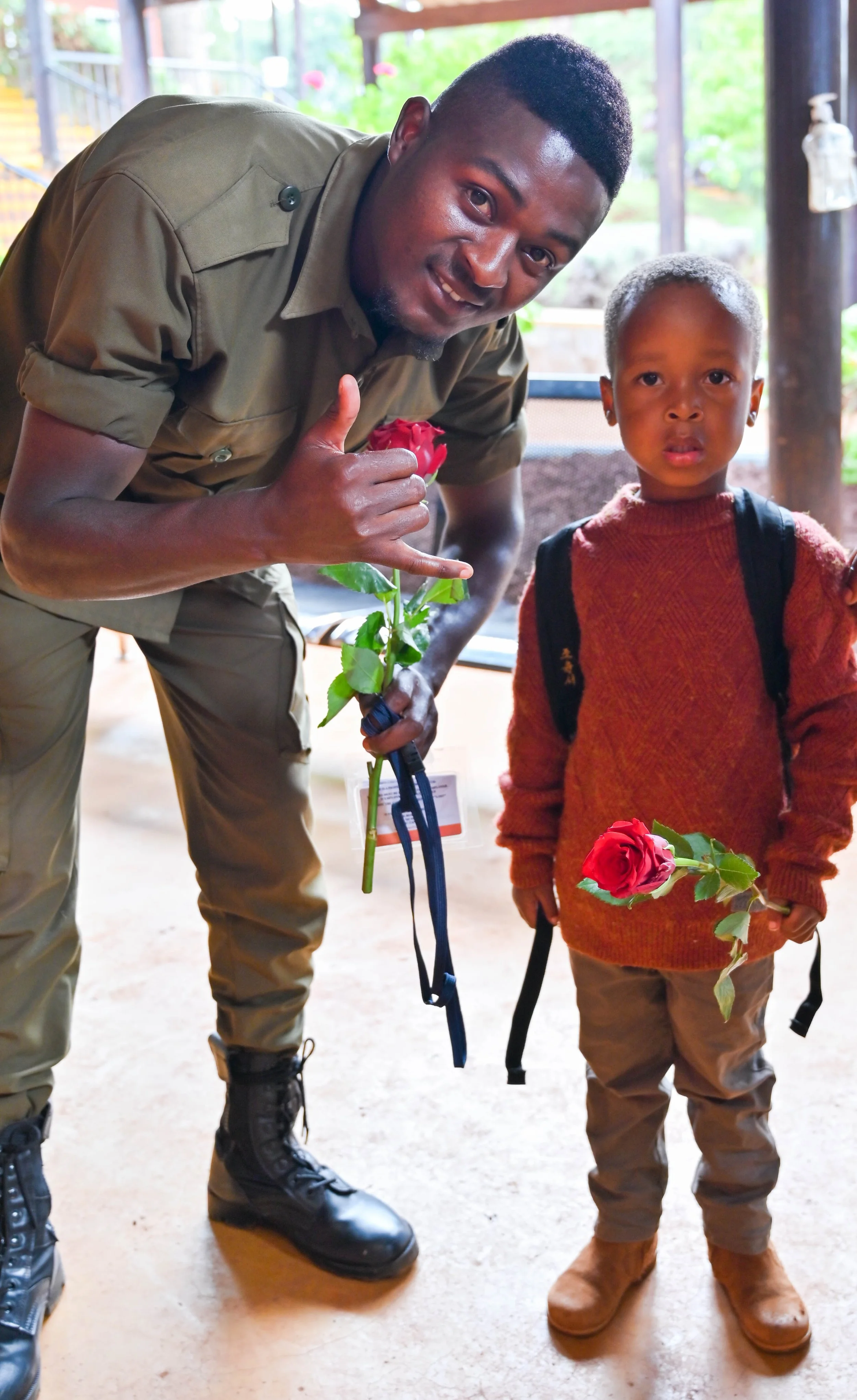
Happy Valentine's Day From FAME

Love is in the air at FAME! 

Happy Valentine’s Day to our FAME family! 

On this day to celebrate love, FAME wanted to show a little extra appreciation and gratitude to our staff and patients by bringing them some love and joy to make their day brighter!

Whatever your plans this Valentine's Day, consider spreading love to Tanzania's rural and underserved communities, who struggle with limited or no access to quality healthcare. 

By donating in the name of love, you can help make a positive impact in the lives of the 30,000 patients treated at FAME every year. Every gift makes a difference! Donate here

Pictured: FAME’s Social Worker, Angel Obeid, walked around the hospital spreading love to our patients and staff!

FAME Africa
FAME's Community in Rural Tanzania: As Told by a Patient*

Mzee Lemama

“My name is Lemama** and I am 62 years old. Six years ago, I was involved in a horrible road accident that left me with a huge wound on my right leg. I was rushed to a local hospital, where I spent 90 days as the doctors worked to save my leg. Finally, they told me that since I was not diabetic and yet the wound on my leg kept getting worse, they had no choice but to amputate my leg above the knee. 

I had sold everything to be able to afford my medical bills. I sold a piece of land I inherited from my father that was to go to my sons; I sold my cows and my goats. A leg amputation would significantly impact my ability to earn a living and support myself and my family, as I often rely on manual labor for my livelihood. It would resort to financial hardship until my death. 

Scared, I asked the doctors to give me a few days to think about it. They warned me that delayed amputation could lead to further complications. I talked to my wife about it and she suggested going to Arusha, 90 miles away, for a second opinion. But I couldn’t afford it. 

The local chairman heard about my situation and gifted me some money, but I needed more to cover my expenses to Arusha. So, I started looking for a hospital close to me and that’s when I learned about FAME. At this point, I felt hopeless and struggled to see a positive future. 

When I got to FAME and saw the doctor, I cried. I asked him to save my leg. After much research and consultation with his colleagues, he told me that it was possible to save the leg by doing skin grafting [skin grafting is a surgical procedure in which skin is removed from one part of the body and transplanted to another area, typically to repair a wound. In Lemama’s case, the skin was grafted from his thighs]. I saw the hand of God through FAME that day.

After the successful operation, it was a long road to recovery, but I didn’t mind because I got to keep my leg and FAME was with me all the way. FAME’s doctors, nurses and support staff showed me care and compassion every time I came for a check-up.”

FAME continues to play a vital role in improving the quality of life in this community. It has made us self-sufficient; we don’t have to rely on hospitals miles away when we need critical healthcare. With FAME in reach of where I live, my community has experienced improved health outcomes and fewer illnesses and deaths that can be prevented.
— Mzee Lemama

"I am so grateful to FAME for all you’ve done and continue to do for our community. Your hard work and dedication make a difference in many people's lives! Thank You.”

* The interview has been translated from Kiswahili to English.
**The patient’s name has been changed to protect their privacy.

Mzee Lemama’s joy was clear during the interview!

FAME Africa
Surgical Procedures at FAME

Cecilia

Cecilia* is a 38-year-old woman at FAME’s Outpatient Clinic (OPD), here for her post-surgery consultation. This post-operative check-up will assess her progress after the surgical procedure, address any concerns or complications that may have arisen and ensure that she is on track to a successful recovery. Nine days ago, Cecilia underwent a laparotomy, a surgical procedure to remove a large mass from her uterus.

My lower abdomen had been hurting for over three months before my sister brought me to FAME. I was in pain all the time and my back hurt so much that I could not do my house chores anymore. I also had a fever and was warm to the touch. I visited a local clinic that could not diagnose the problem, but they prescribed a broad-spectrum antibiotic that they said was effective against a wide range of bacteria. Sadly, this did not work. When we arrived at FAME, the doctor performed a pelvic exam and ultrasound and said I needed emergency surgery to remove a growth in my uterus.
— Cecilia

After a successful operation without significant complications or adverse effects, Cecilia’s pain is mostly gone and she is finally starting to feel better. She reports feeling weak and fatigued nine days post-op, but this is normal as the body recovers from the physical stress of the procedure. Her older sister, who accompanied her on this check-up, is nursing her back to health. 

My sister makes sure that I follow all the doctor’s instructions, including attending all doctor follow-up appointments despite us living 86 miles from FAME! She provides me with proper post-operative care to promote healing and prevent complications by ensuring I eat a balanced diet. At the same time, she helps with all my chores at home to prevent me from doing strenuous activities. She has truly been godsent!
— Cecilia

Cecilia poses with her sister at FAME’s Outpatient Clinic (OPD).

Cecilia is grateful to FAME for all the care she has received. 

Without FAME, I would probably be dead by now! I am happy that my sister brought me here. From the moment I arrived, I was impressed by the professionalism and kindness of everyone I encountered, from the reception staff to the medical staff who provided my care. FAME’s facilities were clean and well-equipped and your commitment to providing top-notch medical services was evident in everything you did. This place has been a blessing to my family and me.
— Cecilia

Since being designated a Level 1 District Hospital in 2020, FAME is seeing more and more complex cases requiring surgical intervention. Given the limited number of practicing surgeons in Tanzania, death rates in Tanzania remain high for common, easily treatable conditions like appendicitis, hernia, obstructed labor, bowel obstruction, and burns for lack of surgical capability. Access to safe and timely local surgical services remains critical for those in our catchment area. FAME is investing heavily in growing its surgical capabilities over the next five years to meet this need.

*While the patient’s name has been changed to protect privacy, permission was secured to share her photos and story with FAME supporters and to raise awareness of available medical care at FAME Medical.

FAME Africa
“FAME Is Home Away From Home”

Mary smiles as she is being discharged from FAME’s inpatient ward.

In rural Tanzania, families play a significant role in caring for their loved ones when they are sick. This role can be demanding and require substantial time, energy and resources. Families take on additional responsibilities in many hospital settings, such as providing basic care and supplies to their sick family members. This can be emotionally and financially challenging.

At FAME, we provide all patients admitted to the hospital with food assistance, which reduces the financial burden on families and ensures that patients have access to nutritious meals, which can improve their health outcomes. 

This was especially useful this week when we had a patient from Tanga, a region in northeastern Tanzania 375 miles from FAME. She was admitted to the inpatient ward and was worried that she did not have family nearby to bring her food. This is her story. 

Mary* is a 57-year-old maize farmer who had traveled from Tanga to Karatu just before Christmas to visit her 79-year-old mother, who was sickly and lived alone. 

Almost immediately after I arrived, I could feel I was not well. I had headaches, extreme fatigue and sometimes shortness of breath. I didn’t feel like myself at all. I visited a local clinic that diagnosed me with typhoid and gave me some medicine, but this did not work. My condition continued to worsen. I started becoming dizzy and feeling faint all the time. I had come to Karatu to help my sickly mother, but now she was taking care of me. She suggested I come to FAME, a hospital she had been to many times with good outcomes. However, she was too weak to bring me, so with the little money I had, I called a taxi that brought me to FAME.
— Mary

Once at FAME, Mary had blood and urine tests done. She was diagnosed with iron deficiency anemia. Anemia is a common health problem in Tanzania, particularly among women and children. The leading causes are an iron-deficient diet and malaria (WHO). At FAME, we saw 390 cases of anemia in 2021 and 318 cases in 2022. The Tanzanian government has implemented programs to address anemia in Tanzania, including distributing iron supplements, promoting malaria prevention and treatment and providing nutrition education. 

In Mary’s case, the anemia was caused by repeated malaria infections. Some of the most common symptoms of anemia are fatigue and weakness. Long-term anemia can lead to cardiac problems such as heart failure and high blood pressure; in severe cases, anemia can lead to death. Mary’s condition required prompt treatment and was admitted to FAME’s inpatient ward.

Tanga, where I live, is known to have a high incidence of malaria because its tropical climate is conducive to transmitting the malaria-causing parasite. I have had malaria several times; I didn’t know it could cause other problems like this.”
— Mary

Mary had to call her mother and let her know that she would be admitted at FAME for a couple of days and would not be going back home right away.  

Pendo, delivering food to patients at FAME’s inpatient ward.

She was very concerned about me, not only because I was much sicker than we had thought, but because she was not strong enough to cook and bring food to me at FAME every day. The hospitals we have been to in the past don’t always provide regular meals for patients, so it’s up to the patient’s family to provide food for them while they are in the hospital.
— Mary

Providing food for patients is important, as proper nutrition is essential for a patient's recovery and can significantly impact patient outcomes and overall health. At FAME, patients are provided with breakfast, lunch and dinner, as well as 10 am and 4 pm snacks such as porridge and fruits. Hospitals in underserved areas, such as where we work, may not always have the resources to provide regular meals for patients. Additionally, patients from these areas are more likely to experience poverty and food insecurity, making it challenging for families to bring food to the hospital regularly. 

It was a huge relief to learn that FAME would provide all meals for me. With my family so far away and my mother unable to do much, I was worried about how I would survive my hospital stay without my family’s support. However, it turned out that I didn’t need any additional support! FAME became my family and helped me in everything. FAME is home away from home! Being here, I have noticed that patients who do not have families visit them do not lack anything, as the food is provided and the nursing staff provides attentive care. Asante Sana [Thank You] FAME!
— Mary

After three days, Mary was discharged to go home. She was given iron supplements to increase the iron in her body and a diet plan to increase iron intake by adding foods such as meat, beans and leafy vegetables to her diet. She was also advised to take preventative measures against malaria, including using bed nets treated with insecticide. 

I feel better and excited to return to my maize farm in Tanga. What was supposed to be a short visit to Karatu turned out to be a month-long adventure! Thank you, FAME, for everything.
— Mary

Editors note: FAME is familiar with patients from faraway places; just last year, we had a patient come from Zanzibar! You can read that story here


*While the patient’s name has been changed to protect privacy, permission was secured to share his photos and story with FAME supporters and to raise awareness of available medical care at FAME Medical.

FAME Africa